Navigating AI Projects: From Exploration to Implementation
Navigating AI Projects: From Exploration to Implementation
Artificial‑intelligence (AI) initiatives often start with a deceptively simple problem statement — “We want to predict customer churn,” or “Can we automate quality inspections?”. Experienced software engineers may assume they can apply familiar project‑management practices and immediately break the work down into tickets and milestones. That mindset works well for deterministic, rule‑based systems, but it rarely works for AI. Unlike traditional software, AI systems learn from data rather than following hard‑coded logic. notes that whereas software developers write explicit rules, AI developers feed a model data so it can learn patterns. This probabilistic nature means success is measured in accuracy and recall rather than “it works every time”. In this blog we explore how to manage AI projects by embracing an exploratory technical‑validation phase followed by implementation and scaling. The goal is to help those new to AI project management understand why a two‑phase approach is necessary and how to communicate it to stakeholders.
Understanding the Problem Statement
An AI project begins with a high‑level business problem. Translating that problem into a feasible AI solution requires more than just specifying features — it requires understanding the problem’s context and data requirements. DataCamp’s AI project cycle recommends using the 4Ws problem canvas — Who, What, Where and Why — to scope the problem. Identify who will be affected, what the problem is, where it occurs, and why it matters. This structured scoping aligns the AI project with business goals and helps uncover hidden assumptions.
Next, evaluate whether there is sufficient data to tackle the problem. AI solutions require clean, well‑organized and relevant data. Key steps include collecting data from diverse sources (surveys, sensors, APIs), ensuring quality through cleaning, selecting relevant features, and addressing ethical considerations. If data is scarce, biased or unrepresentative, the project may not be viable or may require data collection initiatives before modeling can begin.
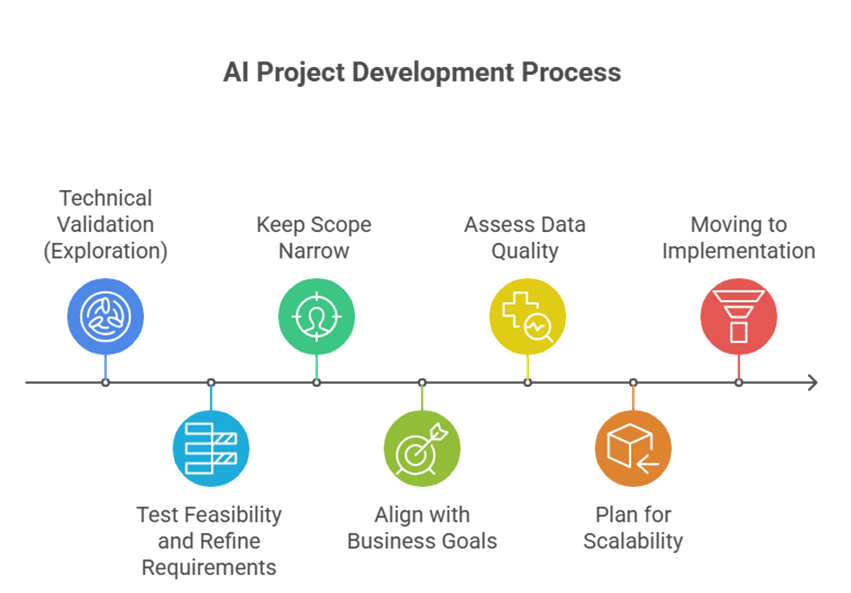
Phase 1: Technical Validation (Exploration)
Once the problem is scoped and initial data is gathered, resist the urge to build production systems. AI projects require an experiment‑first approach. explains that after establishing feasibility you don’t jump straight into code; you enter a phase of experimentation. This phase is sometimes called a proof of concept (PoC) or technical validation. Imaginary Cloud notes that a successful AI PoC combines technical validation with business clarity and follows a structured process that assesses feasibility while building confidence in the solution.
The goals of the technical‑validation phase are to:
- Test feasibility and refine requirements. Unlike traditional projects where requirements are fixed up front, AI projects must validate whether the goal is achievable with available data. During this phase you explore different algorithms and architectures, test preprocessing techniques, and validate whether the data supports the desired outcome.
- Keep scope narrow. A common reason PoCs fail is an overambitious scope; narrowing the focus to a single well‑defined objective improves the chances of success. Define clear success criteria (e.g., accuracy thresholds, recall targets) and a limited timebox (often a few weeks) so results can be assessed objectively.
- Align with business goals. Technical success alone is insufficient. Ensure that the experiment measures business impact and uses key performance indicators (KPIs) agreed with stakeholders. Misalignment between data scientists and decision‑makers is a major cause of failed PoCs.
- Assess data quality. Poor data quality or limited access can invalidate results; conduct a thorough data readiness assessment before developing models.
- Plan for scalability. Temporary scripts may work for prototypes but will fail when scaling. Consider modular code, reusable pipelines and MLOps practices early on to avoid technical debt.

Activities in the Technical‑Validation Phase
- Data exploration and preparation. Use data exploration techniques to understand distributions, identify patterns and detect anomalies. DataCamp highlights the importance of spotting patterns, visualizing data and handling outliers before modeling.
- Model prototyping. Build simple models using different algorithms (logistic regression, decision trees, neural networks) and assess their performance. This step involves training models, fine‑tuning hyperparameters and comparing alternatives.
- Evaluation. Evaluate prototypes using metrics such as accuracy, precision, recall and F1 score. Perform cross‑validation and test on unseen data to ensure generalizability.
- Iteration and learning. Treat experiments as learning milestones rather than deliverables. Each iteration should provide insights that either confirm feasibility or reveal limitations. Document findings — both successes and failures — to inform the next phase.
- Stakeholder review. Present results to business stakeholders and decide whether to proceed, pivot or abandon. Imaginary Cloud stresses the need for go/no‑go frameworks to avoid endless PoCs. Evaluate the PoC against predefined success thresholds and decide on the next steps.
During this phase, communicate clearly that the goal is validation, not final delivery. Some experiments will fail; that is expected. Framing this phase as technical validation manages expectations and prevents frustration when outcomes are uncertain.
Phase 2: Moving to Implementation — Standard software development cycle
Once a PoC demonstrates that the AI approach is viable and aligned with business goals, the project moves into the implementation phase. This phase resembles traditional software development but still retains AI‑specific considerations.
Building a cross‑functional team
Lantern Studios’ AI strategy guide emphasizes that successful implementation requires a team with diverse skills: data scientists, data engineers, domain experts and project managers. Bringing together technical and business expertise ensures that models reflect real‑world constraints and that development aligns with organizational needs.
Developing and testing prototypes
Implementation begins with building and testing AI prototypes based on the validated PoC. Key activities include data preparation, model development and validation. Although technical validation may have used rough notebooks, the implementation phase formalizes the codebase, establishes data pipelines, and integrates version control. This is where best practices from software engineering — code reviews, continuous integration and deployment — become essential.
Integration with business processes
AI models must be embedded into operational workflows. Lantern Studios notes that integration involves embedding AI into existing workflows, training users and ensuring compatibility with current systems. Without proper integration, even the most accurate model may fail to deliver value.
Scaling and maintenance — ML Ops or LLM Ops or Agent Ops
As solutions mature, they need to scale. Scaling may involve replicating successful models across departments or enhancing the depth of AI solutions. Indicators that you are ready to scale include demonstrated success, stakeholder buy‑in and a scalable infrastructure. Best practices for scaling include standardizing processes, using modular architectures, implementing continuous monitoring and preparing the organization for change.
Deployment and maintenance also require consideration of MLOps — automated pipelines for training, testing and deployment. DataCamp highlights that deployment involves integration, performance monitoring, scalability and maintenance. After deployment, ongoing monitoring, retraining and feedback loops are necessary to combat model drift. AI systems are never finished; they need continuous improvement.
Communicating With Stakeholders
Many AI initiatives fail because stakeholders do not understand why a proof‑of‑concept phase is necessary. According to research highlighted by Space‑O AI, 70 % of companies report minimal or no impact from their AI initiatives because they lack a structured approach. Gartner predicts that 30 % of generative‑AI projects will be abandoned after proof of concept by 2025. These sobering statistics underscore the importance of education and communication.
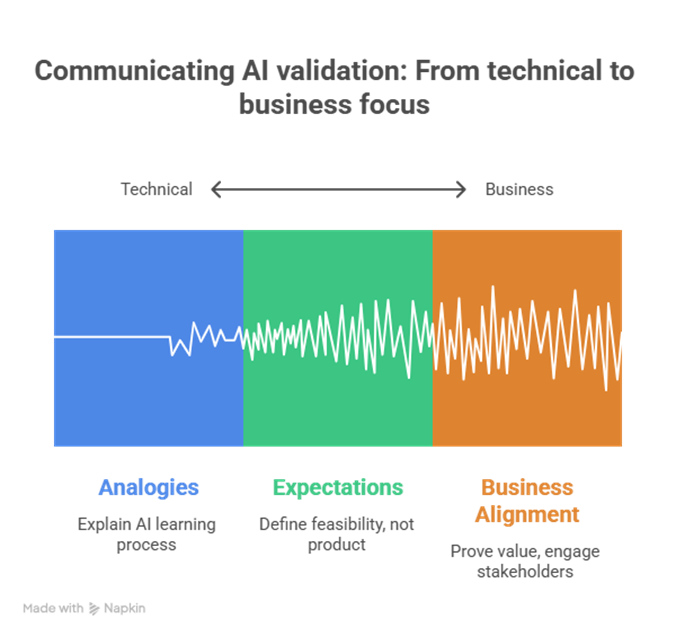
When discussing the technical‑validation phase with non‑technical stakeholders:
- Use analogies. Explain that unlike a standard software project where you write rules, AI projects are like teaching a student; the model learns from examples and its performance is probabilistic. Because learning may or may not succeed, it’s prudent to experiment first.
- Set expectations. Clarify that the PoC is meant to test feasibility, not deliver a polished product. Define success metrics and decision points up front.
- Emphasize business alignment. Reiterate that technical validation must prove not only that the model works but that it delivers business value. Engage stakeholders throughout so they can provide input on KPIs and constraints.
- Share risks and mitigation strategies. Discuss common pitfalls — overambitious scope, poor data quality, misalignment and scalability issues — and how the PoC addresses them.
- Communicate progress transparently. Provide regular updates on experiments, results and next steps. Use visuals and simple language. Celebrate learning milestones even if they reveal challenges.
Finally, remind stakeholders that AI projects are iterative. Even after deployment, models require monitoring, retraining and updates. Framing AI as a continuous journey rather than a one‑off delivery helps secure ongoing support.
Conclusion
AI project management differs fundamentally from traditional software management because AI systems learn from data and produce probabilistic outputs. This uncertainty necessitates an exploratory technical‑validation phase to assess feasibility and align expectations before committing to full‑scale development. During this phase, teams experiment with data and models, define success metrics, and confirm business value. Once validated, they transition to implementation, building robust pipelines, integrating models into business processes, and preparing for scale.
Embracing this two‑phase approach reduces risk and increases the likelihood of delivering AI solutions that truly make an impact. It also gives stakeholders confidence by showing that experiments are deliberate and structured rather than ad‑hoc. As you embark on AI projects, remember that exploration and implementation are complementary: one provides discovery and validation; the other delivers lasting value. By following the practices outlined in this blog — scoping the problem thoroughly, validating feasibility, building cross‑functional teams and communicating clearly — you can guide your organization through the complexities of AI adoption and unlock the transformative benefits of intelligent systems.
References
- DAC.digital — Explains differences between AI and traditional software and emphasises that AI models learn from data rather than follow hard‑coded rules. Discusses the probabilistic nature of AI and the importance of accuracy metrics, continuous improvement and iterative developmentdac.digitaldac.digitaldac.digitaldac.digitaldac.digital.
- DataCamp AI project cycle — Describes the 4Ws problem canvas (who, what, where, why) for scoping AI problems; emphasises collecting and cleaning data, exploring patterns, building and evaluating models, and deploying and maintaining AI solutions with continuous monitoringdatacamp.comdatacamp.comdatacamp.comdatacamp.comdatacamp.comdatacamp.comdatacamp.comdatacamp.comdatacamp.com.
- Imaginary Cloud — Discusses how to run AI proofs of concept and technical validations. It stresses that PoCs should combine technical and business validation, keep the scope narrow, align with business goals, assess data quality, plan for scalability and use go/no‑go frameworks and modular architectures for reuseimaginarycloud.comimaginarycloud.comimaginarycloud.comimaginarycloud.comimaginarycloud.comimaginarycloud.comimaginarycloud.com.
- Boston Technology Corporation — Provides a structure for AI proofs of concept, recommending a four‑ to six‑week timebox with stage gates: Stage A (preparation), Stage B (execution) and Stage C (validation and next steps). Each stage has entry and exit criteria to enable quick decisions and course correctionsboston-technology.comboston-technology.comboston-technology.comboston-technology.com.
- Lantern Studios — Outlines a practical AI project roadmap. It recommends building cross‑functional teams comprising data scientists, engineers, domain experts and project managers; developing and testing prototypes; integrating AI into business processes; scaling based on demonstrated success; and adopting best practices like MLOps for deployment and maintenancelanternstudios.comlanternstudios.comlanternstudios.comlanternstudios.comlanternstudios.comlanternstudios.com.
- PMI CPMAI methodology — The Project Management Institute’s Certified Professional in Managing AI (CPMAI) methodology introduces a six‑phase, data‑centric approach tailored for AI projects: business understanding, data understanding, data preparation, model development, model evaluation and model operationalisation. It emphasises iterative cycles, alignment with business objectives, ethical considerations, stage gates and cross‑functional collaborationpmi.orgpmi.orgpmi.orgpmi.orgpmi.orgpmi.orgpmi.orgpmi.orgpmi.orgpmi.orgpmi.orgpmi.orgpmi.org.
- Space‑O AI and Gartner insights — Summarises statistics indicating that many AI initiatives fail or deliver minimal impact because they lack structured approaches. Notes Gartner’s prediction that around 30 % of generative‑AI projects will be abandoned after proof of concept, underscoring the importance of effective project managementspaceo.aispaceo.ai.


Comments
Post a Comment